 Property Care
Home › The Room Refresh
One room. Every trade it needs. A single price.
Whole-room renovation across Godmanchester, Huntingdon and Cambridgeshire. Here is the quiet scandal of the trades: the room is never anyone's job. So we made it ours, and it became the service the rest of the business is built around. This is the general case. Give it a reason and it becomes a nursery, a home adapted for staying put, a house prepared for sale or a property reset between tenants. The work underneath is the same.
We look after the room, not the trade
A Room Refresh begins with a walk round the room together. Not just the thing that prompted the call, but everything the room has been quietly putting up with: the scuffed skirting, the rattling handle, the blind that never sat straight, the paint that gave up behind the radiator, the socket that has leaned like Pisa since the extension.
Then everything goes into one written scope with one fixed price, and the room is taken from tired to finished in a single run of work. When we leave, there is nothing left on the list, because the list was the point.
Nobody else structures work this way, because the trades are organised by skill and priced by the visit. We are organised by the space and priced by the outcome. That is the whole difference, and once you have experienced it, the old way feels absurd.
What you notice afterwards is not the paint. It is that the room simply works: better flow, better function, and one less thing quietly asking something of you every day.
Most refreshes arrive at a turning point: a spare room becoming a nursery, a box room becoming a proper bedroom, a house being made ready to sell. We have written about those moments in the chapters of a home.
A refresh, room by room
The living room
Walls made good and decorated, woodwork refreshed, doors eased and furniture-worn floors treated. Shelves finally level, sockets finally straight, and the snags of daily life gone in one pass.
The study
For everyone now working where they live. Purpose-built shelving and storage, lighting that flatters neither headaches nor video calls, cables tamed, the sticking window eased, and a room that finally encourages concentration.
Kitchen & bathroom
Short of a full refit, most kitchens and bathrooms want a refresh: doors and drawers re-aligned, handles replaced, sealant renewed, grout revived, tired walls decorated, and extraction that actually extracts. Transformation without the skip. And if it really is beyond that, we do full refits too.
The bedroom
Decorated calm, wardrobe doors that glide, blinds and curtains hung properly, draughts excluded, and the creaking floorboard silenced at last. Sleep is maintenance too.
The hallway
The hardest-working room in the house and the first one guests meet. Scuffs gone, banister solid, coat storage that copes with a real family, and a front door that closes like it means it.
The spare room
The room that became a cupboard. Cleared purpose, proper storage, fresh decoration, and a plan for what it wants to be next: guest room, study, nursery or simply a room again.
Why rooms fall between the trades
The plasterer does not decorate afterwards. The chap fitting your new door would never think to straighten the crooked socket beside it, or ease the window that has stuck since 2019. Each trade does its trade and leaves.
Trades think in trades
Each specialist arrives, does their specialism well, and leaves the rest exactly as found. Nobody is being lazy. It is simply how the industry prices a visit.
We think in rooms
One scope covers plastering, decorating, joinery, fixings and finishing, with our trusted network folded in where a specialist is needed. The room is the unit of work.
You get a finished room
Not a decorated room with a sticking window. Not a new door beside a crooked socket. Finished, in the sense your grandmother meant it.
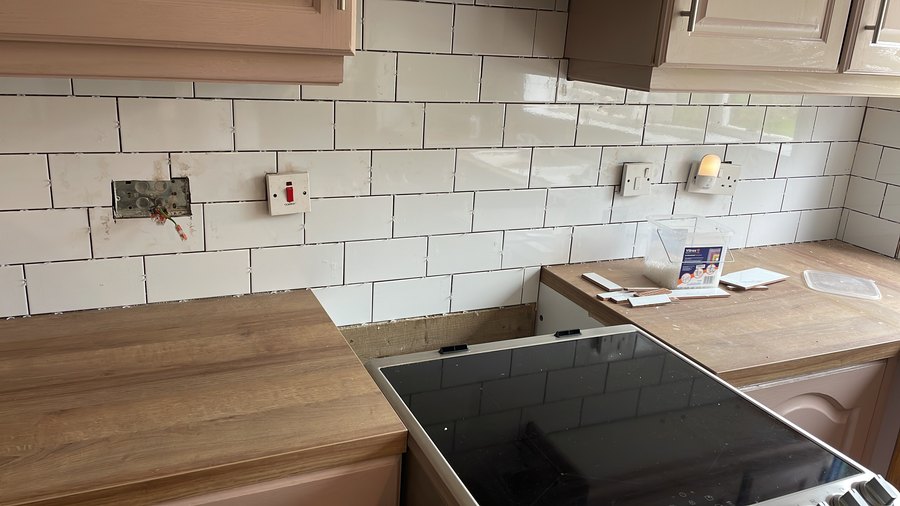
A kitchen, mid-refresh
A refresh rather than a refit. The units stayed and were repainted, the worktops and hob went in first, and the tiling was set out to them afterwards. The sockets were brought up to date while the wall was open, which is the cheapest moment to do it and the most expensive one to skip.
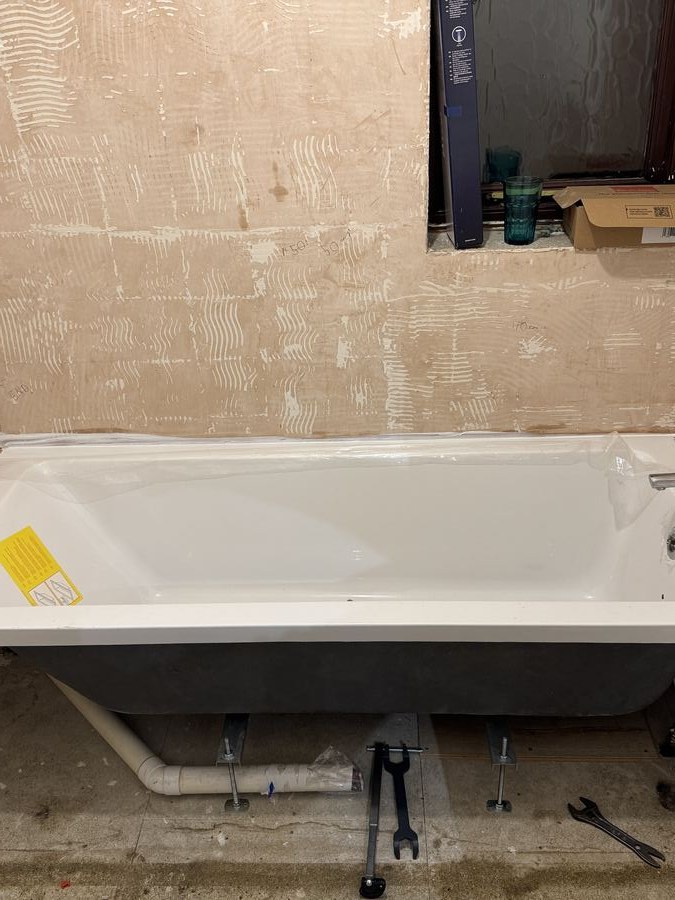
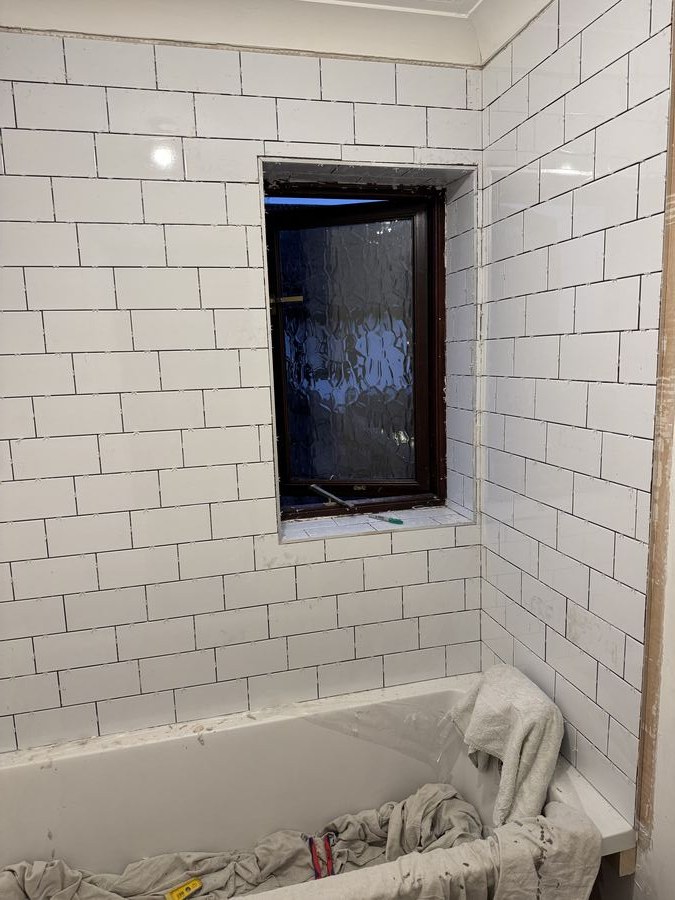
A bathroom, taken back to nothing
Most of what you pay for in a room like this is invisible by the end. Suite out, pipework rerun, walls made flat and true, boards sealed and primed. Get that wrong and the prettiest tiles in Cambridgeshire will not save it. Get it right and the finish looks after itself for twenty years.
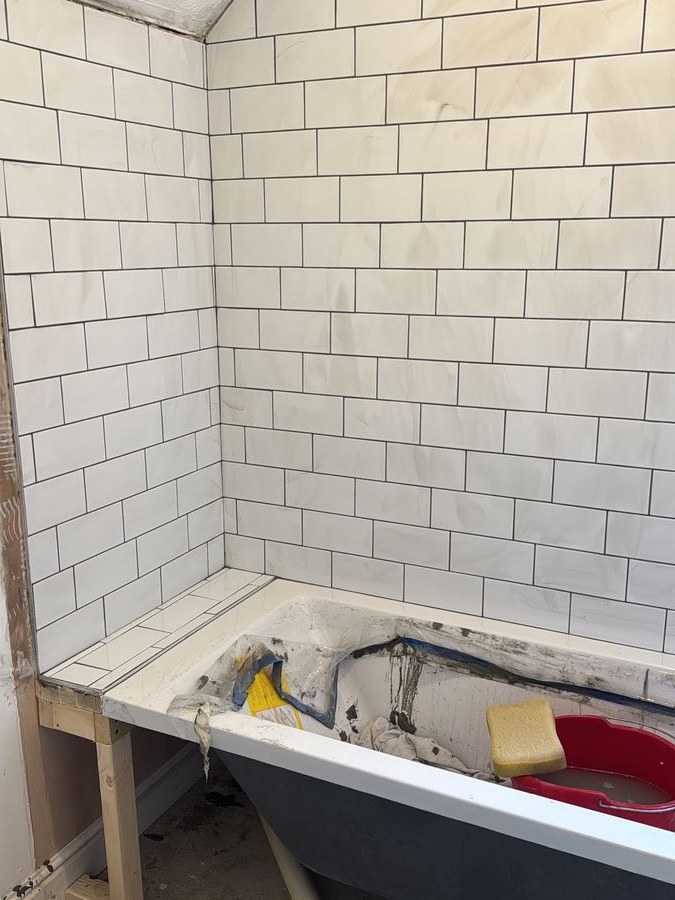
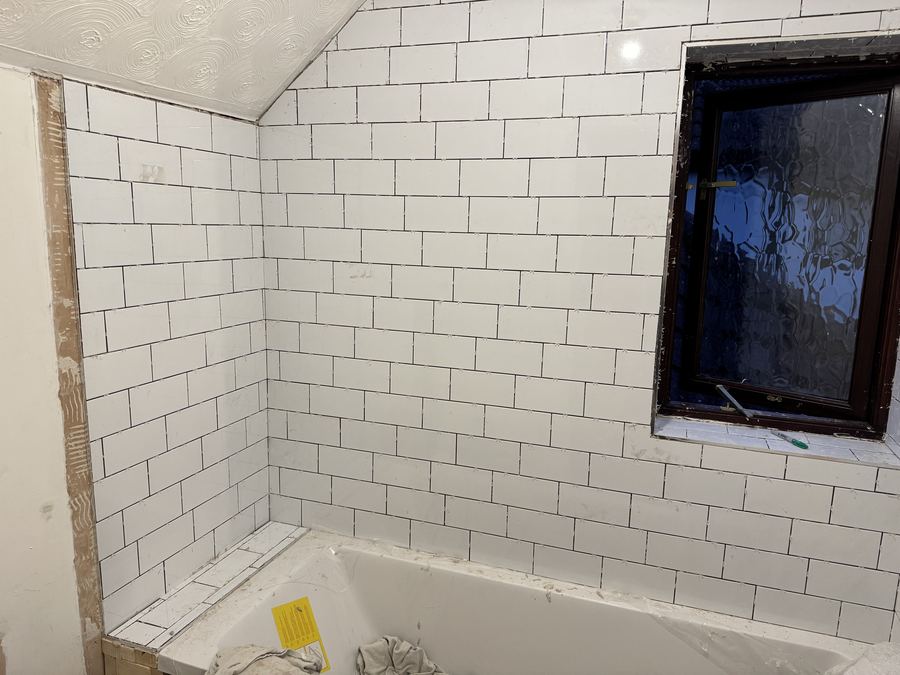
A different house, tiling going up
A different job, and worth a look for the setting out. Tiling starts from a batten screwed level across the wall, never from the floor, because floors are rarely level and the error runs all the way up.
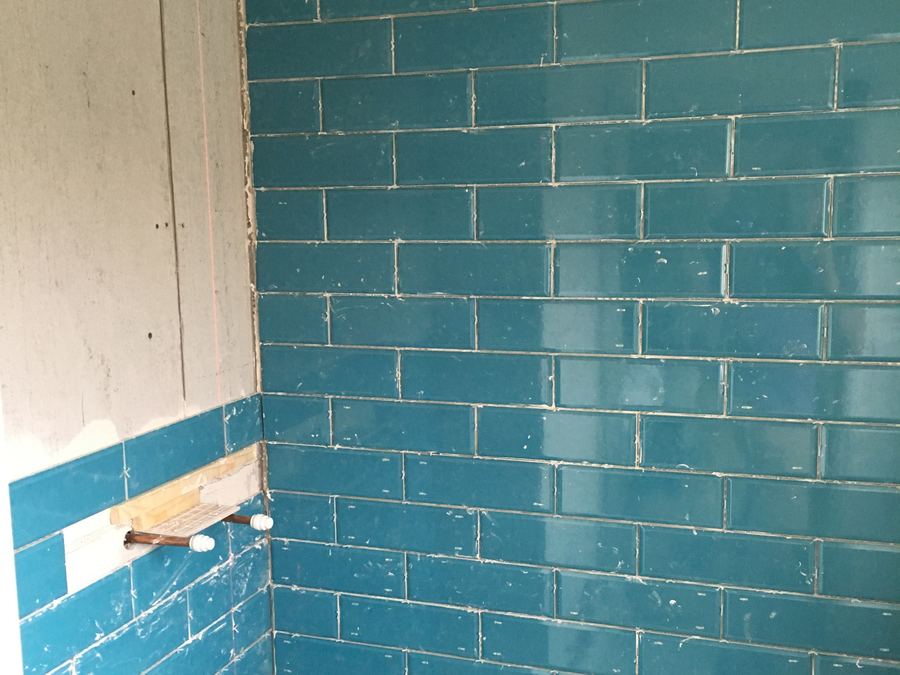
These were taken with a phone, mid-job, by someone with dusty hands. We would rather show you the middle of a room than a styled photograph of the end of one. Where two jobs appear on this page we have said which is which, because a before-and-after that quietly stitches two houses together is not a before-and-after. Finished-room pictures are coming as we build the portfolio.
Finished is not the same as yours
A Room Refresh leaves you a room that works. Straight walls, level shelves, a door that closes, everything on the list done. What it does not do on its own is make the room feel like it was made for you. Most of what does that is the part nobody else offers: the seat built into that awkward corner, the cushion cut to the chair you already own, the blind made to a window that is not a standard size, the cupboard whose inside finally makes sense.
All of it is possible in the same run of work, at the same written price, while the room is already open and we are already there.
Built to fit
A banquette in the corner of the kitchen. A bench in the hall with the shoes underneath rather than across the floor. A headboard that makes the wall the point of the room. Storage inside a cupboard you already have, designed round what you actually keep in it rather than another shelf.
Made to fit
Curtains, fabric blinds and cushions, measured in your room and made to those measurements rather than ordered to the nearest standard size and packed out with hope. We make them ourselves, which is why they arrive as part of the same job instead of a separate order with its own lead time and its own person to chase.
Found to fit
Sometimes the thing a room needs is one piece, and it does not exist in a shop. A mirror of the right proportion for that chimney breast. A chair for the corner of a nursery. We will go and look for it, for a fixed fee that comes off the price if we find something you buy.
And what you already own
Old varnish taken back, chalk paint, waxed, and a piece you were going to replace becoming the reason the room works. The same goes outside: teak gone silver sanded back and re-oiled, a bench re-slatted where it has rotted at the feet rather than skipped, and cushions cut to the set you already have in a fabric meant for weather.
The eye comes with the work. We are not interior designers and will not pretend to be. But there is somebody in this business with a very good eye and a real interest in how a room hangs together, and it arrives with the job rather than as a line on the invoice.
Where the light actually falls. What should be the one thing you notice walking in. Which wall wants the colour, and which is better left alone. Take it or leave it entirely. If you would rather be told the price and left to choose things yourself, say so and that is exactly what happens.
You choose and buy it, exactly as with tiles and worktops on a refit, and we measure, make and fit. It keeps us out of holding stock and out of arguing with you about taste, and it means you are never limited to a range we happen to carry.
Full kitchen and bathroom refits
A refresh is the right answer far more often than people expect, and we will say so when it is. But sometimes the units are swollen at the bottom, the bath is avocado, the layout has been wrong since 1987, and no amount of new handles is going to fix it. We do those too.
What we cannot do is quote one from a website, and neither can anyone else who is being straight with you. A refit is the most variable job in this trade: two identical houses can differ by thousands depending on what is behind the old tiles, whether the soil pipe has to move, and what you choose to put back in.
So here is the actual shape of it instead.
A bathroom
On an ordinary three-bedroom house with a bathroom of roughly 2.5 by 2 metres, our part usually lands between £3,800 and £6,000. Strip out and disposal, floor and walls prepared and levelled, boarding, full tiling, the suite fitted, second fix, sealing, extraction, making good and decorating.
A kitchen
For a typical eight to twelve unit kitchen, our part usually lands between £4,400 and £7,000. Strip out and disposal, walls and floor prepared, units and doors fitted and levelled, worktops coordinated, splashbacks tiled, second fix, appliances fitted, sealing, making good and decorating.
The things you choose, and which vary far more than our labour ever will: units, worktops, appliances, the suite, tiles and flooring. You buy those, at whatever level suits you, and we will happily come round the showroom and tell you which of it is worth the money.
Gas work belongs with a Gas Safe registered engineer, unvented cylinders with someone G3 qualified, and notifiable electrical work, meaning new circuits, consumer units or anything inside the bathroom itself, with a registered electrician. They contract with you directly and bill you directly, so there is no margin of ours buried in their invoice. We coordinate around them, so you still have one conversation to manage rather than five.
Moving a soil pipe, taking out a wall, underfloor heating, a floor that turns out to be rotten, or a period house where nothing is square. We find most of that on the first visit, tell you before you commit, and put it in the written price rather than discovering it halfway through.
By the room, in writing
We walk the room, agree the scope, and quote one fixed price for the whole transformation. No day rates, no trade-by-trade invoices, no surprises. If we uncover something unexpected once work begins, we stop, show you, and agree the way forward before it costs a penny.
The plasterer will not decorate afterwards. The door fitter will not straighten your sockets. We were never able to explain why not, so we built the answer.
Most refreshes land between £1,000 and £2,000. A hallway is typically around £1,080, a bedroom £1,230, a study £1,370, a bathroom £1,365, a kitchen without a refit £1,495 and a living room £1,760. The bundle already includes the discount for booking the room rather than the trade, and your written price follows a proper look at the space.
These are starting points, not a menu. Combine them, split them, or ask for the one job you actually want. If that is a single curtain pole, send us that one line and a single curtain pole is all we will price.
Three more things
The clean is included, and it is not a token one. Dust gets everywhere in a room that has been taken back and rebuilt, including on top of things nobody thinks to look at. So the last part of the job is a proper builder's clean: surfaces, sills, frames, glass, floor and the carcasses of anything fitted. You should be able to move furniture back the same evening rather than spending your Saturday finishing our work for us.
The name is the point. Prana is an old word for breath, the life in a thing. A room that has been properly prepared, finished and put back together feels different to be in, and everyone notices it without being able to say why. That feeling is what you are actually paying for.
And afterwards. The room you have just paid for will look after itself for years. The rest of the house will not, and that is usually the conversation we have on the last day. A care plan is how the other rooms avoid reaching the state this one was in.
Which room has been waiting longest?
Send us a few photos of the room as it really is, clutter and all, and we will come back with a realistic figure and what a refresh would involve. Then we walk the room together before anything is fixed, because half the value of a refresh is spotting what you have stopped noticing. It will be one of us at the door, not a stranger off a rota.
A finished room stays finished for a long time if somebody is keeping half an eye on the rest of the house. That is what a care plan is for, and it is worth knowing about before you decide, rather than being offered it afterwards like an extended warranty at a till.